The Six-Month Presidency: How Cyprus Took Over the EU Council and Immediately Got Caught Helping Russians Evade Sanctions
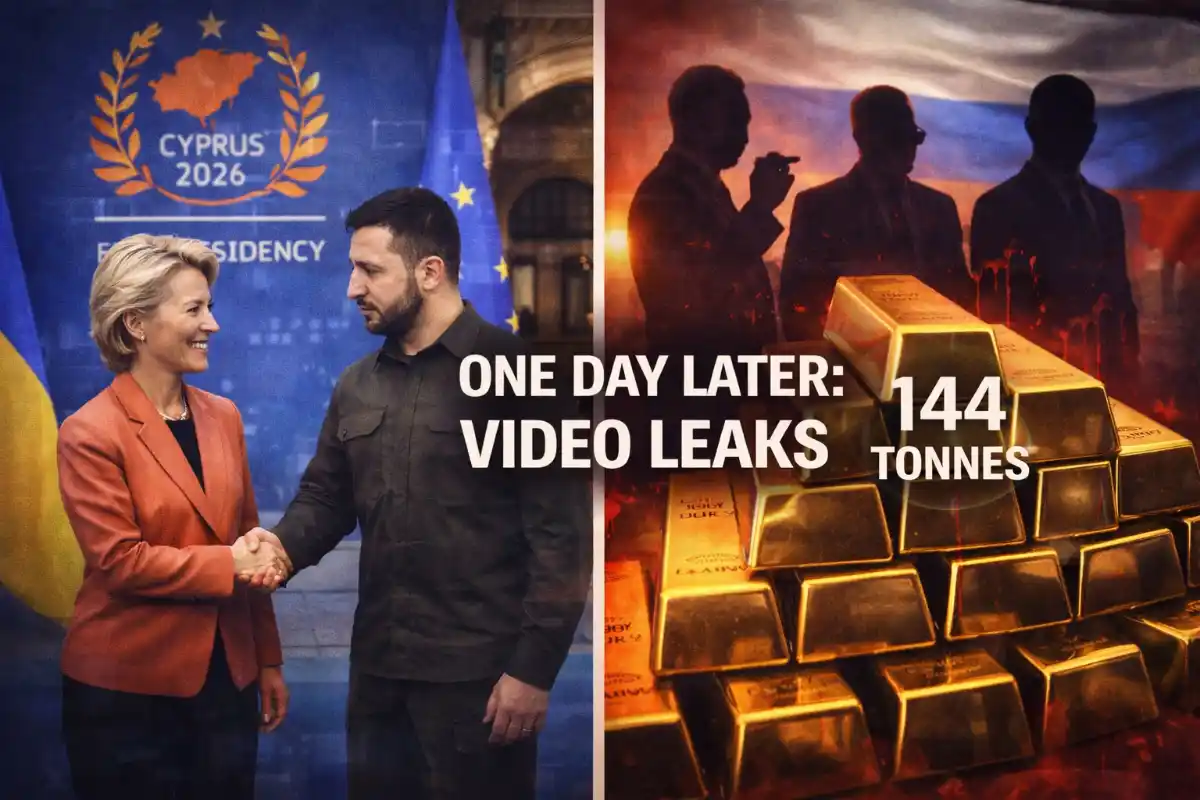
Cyprus assumed EU presidency to lead on sanctions and rule of law. One day after ceremony with Zelensky and von der Leyen, video leaked showing officials helping Russian oligarchs evade sanctions for cash.
On January 1, 2026, Cyprus assumed the rotating Presidency of the Council of the European Union. The island nation, population 1.2 million, the EU's smallest member state, was handed responsibility for steering the bloc's agenda for six months. Security, migration, Ukraine support, defense readiness, the rule of law. These were the priorities President Nikos Christodoulides announced with suitable gravitas on December 21, 2025.
On January 7, Christodoulides hosted a high-profile ceremony in Nicosia. European Commission President Ursula von der Leyen attended. So did Ukrainian President Volodymyr Zelensky. The message was clear: Cyprus, despite its size, despite being partially occupied by Turkey since 1974x, was ready to lead Europe through turbulent times.
The truth doesn’t trend. It survives because a few still care enough to keep it alive.
Keep The Kade Frequency transmitting.
Twenty-four hours later, a video appeared on X.
Eight and a half minutes long. Posted by an account called Emily Thompson (@EmilyTanalyst). The footage showed senior Cypriot officials, people close to Christodoulides, people in positions of power, discussing how to circumvent campaign finance laws. How to funnel undisclosed cash through relatives and corporate "social responsibility" contributions. How to provide "cash-for-access" to the presidency.
And most damningly: how to help Russian oligarchs evade EU sanctions in exchange for substantial payments.
The video went viral. Within days, the presidential chief of staff resigned. The First Lady stepped down from her charity role. The government scrambled to call it Russian disinformation, a "hybrid attack," malicious editing.
But here's the thing about Cyprus: the corruption isn't a lie. The video might be, probably is, a Russian operation. The timing screams Kremlin revenge. But the underlying rot? That's been documented for decades by investigators, journalists, the EU itself, and even U.S. law enforcement.
Cyprus didn't become "Moscow on the Mediterranean" by accident. It built that reputation transaction by transaction, shell company by shell company, golden passport by golden passport. And now, as the island tries to rebrand itself as a loyal Western ally while steering the EU's agenda on sanctions enforcement and the rule of law, its past has come back with perfect timing to embarrass it on the world stage.
What Was in the Video?
The footage surfaced on January 8, 2026. Emily Thompson's X account had the usual markers of a fabricated persona, stock photo, recent creation, suspiciously perfect targeting. But the content was real enough.
Three men appear in the video. Charalambos Charalambous, the president's chief of staff and brother-in-law. Giorgos Lakkotrypis, former energy minister, now consul of Kazakhstan. Giorgos Chrysochos, CEO of Cyfield Group. All close to Christodoulides. All discussing things they probably assumed would stay private.
The narration, delivered in a polished British accent, lays out the allegations:
- President Christodoulides "smashed" the €1 million legal cap on campaign spending through a "shadowy family network" during his 2023 presidential bid
- Undisclosed cash donations were disguised as corporate social responsibility contributions
- A company associated with the presidential circle provides assistance to sanctioned Russian oligarchs in evading EU sanctions
- These services are exchanged for "substantial payments" funneled as cash to the government or campaign
Specific names surface. LetterOne, the Luxembourg-based investment company. Two of its major shareholders: Mikhail Fridman and Petr Aven, both sanctioned by the EU. Lakkotrypis appears in the video saying: "I worked hard to ensure that Cyprus took a firm stance against their sanctions."
The implication: cash bought influence. The Court of Justice of the European Union lifted sanctions against Fridman and Aven on April 10, 2024.
Independent investigations. Imperial expansion exposed. Pattern documented.
Get investigations delivered.
Another transaction detailed: Remedica, a pharmaceutical company, donated €75,000. Remedica is owned by LetterOne. The video suggests this was political money laundered through charity.
The government immediately labeled it disinformation. Cyprus Security Services conducted an analysis. Their finding: the video exhibits "the characteristics of organized Russian disinformation campaigns" known as Doppelgänger, similar to operations that targeted France, Germany, the U.S., and Israel.
Charalambous filed a police complaint. He insisted his remarks were taken out of context, deliberately distorted. He resigned anyway. So did First Lady Philippa Karsera from her charity position.
Christodoulides went on the offensive. "I want to publicly call on anyone who has evidence of direct or indirect financing of me, either during the pre-election campaign or during my presidency, to submit it immediately to the competent state authorities," he said. "I will not allow, to anyone, the right to accuse me of corruption."
Fair enough. Except Cyprus has a documented history of exactly the kind of corruption the video alleges. And investigators have been screaming about it for years.
How Did Cyprus Become Moscow's Money Laundromat?
The Cyprus model, as it became known, relied on an oversized financial sector, some of the EU's weakest financial disclosure laws, an indulgent central bank, and a tsunami of Russian money.
How much Russian money? Try $200 billion in investment. At one point, Russian-owned companies controlled up to 80 percent of the wealth in Cyprus. The island earned a nickname: "Moscow on the Mediterranean."
This wasn't organic economic activity. It was a deliberate system. After 1989, when Russian oligarchs "stole the property of the Russian people and started to build their empires," they needed somewhere safe to hide their assets. Cyprus offered the perfect combination: low taxes, strict corporate secrecy, EU membership (after 2004), European Central Bank supervision, and a political class willing to look the other way.
The numbers are staggering:
- 125,000+ bank accounts closed in recent years as Cyprus tried to clean up
- 42,000+ shell companies terminated
- 3.6 million leaked documents analyzed by the International Consortium of Investigative Journalists (ICIJ) in the Cyprus Confidential investigation
- 67 of 105 Russian billionaires on the 2023 Forbes list used Cyprus financial services to hide wealth
- At least $4.6 billion moved through the Troika Laundromat, a Cyprus-linked money laundering network
Russian deposits in Cyprus banks? $31 billion, larger than the island's entire GDP.
The infrastructure was sophisticated. Shell companies stacked like Russian nesting dolls, addresses in the British Virgin Islands and Jersey, all leading to anonymous trusts in Cyprus. Take Roman Abramovich's planes. U.S. investigators traced them through five shell companies before finding the Cyprus trust at the center.
The service providers? An army of 4,000 lawyers, Big Four accounting firms like PwC Cyprus, offshore specialists, bankers. All working together to construct opacity. All deeply intertwined with the political class.
How intertwined? From 2013 to 2023, Cyprus was run by Nicos Anastasiades, founder of a major offshore services law firm. Before he became president, his firm's partners served as officials of shell companies linked to massive suspected money laundering operations, including deals connected to Putin allies.
His firm moved millions through shells entwined with the Troika Laundromat. One investigation found bank records linking Anastasiades' firm to the infamous Magnitsky scandal. When he took office in 2013, he transferred his firm shares to his two daughters.
Anastasiades' government also ran the Golden Passport program. Pay enough money, get Cyprus citizenship, and with it, access to the entire European Union.
At least a dozen now-sanctioned Russian oligarchs got golden passports:
- Igor Kesaev – owned a Russian arms factory
- Alexander Ponomarenko – chairman of Russia's biggest airport, called one of Putin's "enablers" by the U.S.
- Oleg Deripaska – aluminum tycoon, part of Putin's inner circle, investigated for money laundering, illegal wiretapping, and extortion
The program was shuttered in 2020 after protests and EU pressure. But the passports remained valid. Cyprus has since revoked 270, initiated 15 corruption prosecutions related to the scheme. But the damage was done. The door to Europe had been opened to criminals with the full cooperation of the Cypriot state.
What About the Banks?
Russian oligarchs didn't just hide money in Cyprus. They owned the banks.
After the 2013 financial crisis, Cyprus needed a bailout. The European Central Bank agreed, but there was a problem: Cyprus banks were stuffed with $31 billion in Russian money, much of it believed to be dirty. Germany, as Europe's dominant economic power, would fund most of the bailout. "EU Aid for Cyprus a Political Minefield for Merkel,"declared Der Spiegel. The subhead: "Bailing Out Oligarchs."
A leaked German intelligence report suggested the main beneficiaries would be Russian oligarchs, businessmen, and mafiosi. Cyprus bank regulators had been running interference for the Kremlin. In one case, they refused to investigate a $230 million Russian tax fraud, a large share of which had been laundered through Cyprus banks.
The bailout happened. But there was a twist: a "bail-in." Instead of taxpayer money, large depositors took the hit. Their deposits were converted to bank equity.
Who were the large depositors? Russians.
Independent investigations. Imperial expansion exposed. Pattern documented.
Get investigations delivered.
The Bank of Cyprus emerged from the crisis with six Russians on its board, including Vladimir Strzhalkovsky, Putin's former KGB colleague from Leningrad. The single biggest shareholder was a company controlled by Viktor Vekselberg, a now-sanctioned oligarch.
The Russian Commercial Bank (RCB) in Cyprus? Putin himself once mistakenly called it a "subsidiary" of Kremlin-controlled Vneshtorgbank, known as VTB. Three of Cyprus's top four banks were soon implicated in Kremlin-linked money laundering scandals.
And yet, all of these banks were licensed and directly supervised by the European Central Bank in Frankfurt. They were wired into the Western financial system. That was the value proposition: Russian money could enter the EU banking network through Cyprus.
One more detail. In 2014, the Central Bank of Cyprus approved a Russian investor group to buy a controlling stake in the Cyprus Development Bank. That group included Alexey Kulikov, part-owner of a bank that Russian authorities alleged helped orchestrate one of the largest money-laundering operations in history, $10 billion moved from Russia to Europe.
In May 2014, the Central Bank of Russia revoked the license of Kulikov's small Russian bank for money-laundering violations. A month later, the Cypriot central bank approved the acquisition anyway.
Has Cyprus Actually Cleaned Up?
After Russia's full-scale invasion of Ukraine in February 2022, Cyprus faced a choice: keep serving Russian oligarchs or align with the West.
Publicly, the island chose the West. Cyprus cut ties with Russia, or claimed to. The government says it shut down tens of thousands of Russian shell companies and bank accounts. Russian tourism collapsed by more than 90 percent. Inward investment from Russia fell sharply. Commercial ties were unwound.
The numbers the government cites:
- 125,000+ bank accounts closed
- 42,000+ shell companies terminated
- Russian clients: down to 0.35% of the banking customer base, from 2.7% in 2024
- €105 million in Russian deposits seized
The Council of Europe's MONEYVAL body placed Cyprus in the "top quartile globally" for effectiveness in combating money laundering. The IMF credited Cyprus with halting new economic activity with Russia altogether. The U.S. State Department praised Cypriot progress.
But the ICIJ's Cyprus Confidential investigation, published in November 2023, told a different story. The leaked documents, 3.6 million of them, dated primarily from the mid-1990s to April 2022, showed extensive Russian abuse both before and after the invasion.
Key revelations:
PwC Cyprus helped sanctioned oligarchs transfer assets as Russian tanks rolled into Ukraine. In spring 2022, scientists-turned-billionaires Alexander Abramov and Alexander Frolov rushed to move $100 million between two shell companies they controlled. The original source: Evraz PLC, the steel and mining giant that produces 97% of the metal used in Russian railways.
Two months after the transaction, the British government sanctioned Evraz as "of strategic significance to the government of Russia." It later imposed asset freezes and travel bans on Abramov and Frolov, noting them as members of Putin's "cabal of selected elite."
PwC Cyprus also helped Alexey Mordashov, another sanctioned billionaire, transfer a $1.4 billion stake in German travel firm TUI Group to his wife Marina, one day after EU sanctions were imposed. German authorities later blocked the transfer provisionally.
Roman Abramovich, former Chelsea owner, sanctioned oligarch, had numerous companies and trusts managed by Cyprus firms Cypcodirect and MeritServus. The UK later sanctioned MeritServus for allegedly helping Abramovich hide assets after sanctions.
Pyotr Aven held a significant portion of his wealth in Cyprus-based trusts administered by Abacus Ltd.
Hubert Seipel, the veteran German journalist who wrote two books about Putin with unprecedented access, received over $600,000 from a shell company linked to sanctioned oligarch Alexey Mordashov. One handwritten note on a 2018 document explained the payment as support "for writing a book on [the] political environment in the Russian Federation."
And then there's the stuff that goes beyond money laundering:
Tal Dilian, a former Israeli intelligence officer, used Cyprus to build Intellexa, a notorious cyber-surveillance firm. It sold spyware to brutal regimes: a Sudanese paramilitary group, Egyptian intelligence services. The spyware was used to target Americans. The U.S. sanctioned Dilian and his firm in 2024, then sanctioned more individuals and businesses, including two Cyprus citizens, in September 2024.
Abdelbasit Hamza, a Hamas financier sanctioned by the U.S., held a stake in a Cyprus company.
The pattern is clear: Cyprus firms continued serving sanctioned individuals even after the invasion, even after the island publicly pledged to enforce Western sanctions.
So Cyprus Is Leading the EU on What, Exactly?
Against this backdrop, Cyprus assumed the EU Council Presidency on January 1, 2026.
- Security, defense readiness, preparedness – Christodoulides emphasized "autonomy through security," reducing dependencies, strengthening defense
- Support for Ukraine – described as the "main priority," with pledges of financial support and further sanctions on Russia
- Migration management – implementing the Pact for Migration and Asylum, dismantling criminal networks, strengthening return policy
- Rule of law – promoting "fundamental European values, including the rule of law and equal access to justice"
- EU enlargement – advancing Ukraine, Moldova, Western Balkans membership
- Next EU budget (MFF 2028-2034) – a major negotiation priority
The motto: "An Autonomous Union. Open to the World."
The irony is almost too perfect. Cyprus, which spent decades as a Russian money-laundering hub, now tasked with leading the EU on sanctions enforcement, rule of law, and supporting Ukraine.
European legislators weren't blind to this. After Cyprus Confidential, the European Parliament called Cyprus a "weak link" in the EU's financial system. Sophie In't Veld, then a prominent MEP from the Netherlands, said: "The European Union is turning into a gangster's paradise, because there is complete impunity."
Petar Tanev, an adviser in the European Parliament, warned that the January 2026 video scandal "directly affects Cyprus' institutional credibility within the Council of the EU. The EU presidency is first and foremost a function of trust. The presiding state must be politically neutral, institutionally resilient and reputationally impeccable as an arbiter."
He added: "For the EU, which is currently focused on tightening its sanctions policy against Russia, such uncertainty looks like a weak link within the Union itself."
And yet, the presidency went forward. Christodoulides insisted his hands are clean. He said the video was foreign interference, possibly Russian. Cyprus government spokesperson Konstantinos Letymbiotis called it "hybrid war." Intelligence services launched an investigation, drawing help from the U.S. and Israel. Cypriot media reported a possible link to the Doppelgänger disinformation campaign.
The government's narrative: we're victims of a Russian attack because we shifted toward the West. We cut ties with Moscow after 2022. We shut down Russian shell companies. We're supporting Ukraine. Now Russia is retaliating with hybrid warfare to embarrass us during our EU presidency.
There's probably truth to this. The timing is too perfect. The video's emergence, literally one day after the high-profile ceremony with Zelensky and von der Leyen, screams coordinated operation. The account that posted it looks fake.
But here's what Andreas Mavroyiannis, former Permanent Representative of Cyprus to the EU, told EUalive: "We always suspected that he [Christodoulides] had access to large illegal funds. I have good reasons to believe that these substantial illegal contributions are indeed real. There is also the added factor of Russian backlash, having reportedly provided him with huge sums during his campaign, they now feel betrayed and sold out."
In other words: both things can be true. The video can be a Russian operation and the corruption can be real.
The domestic opposition certainly thinks so. Irene Charalambidou of the left-wing AKEL party said: "If there were no corruption, there would have been nothing to record."
Coalition parties haven't ruled out withdrawing government support over the scandal, which could trigger early elections and completely derail Cyprus's EU presidency.
What Questions Should Brussels Be Asking?
Christodoulides says Cyprus will investigate the allegations. "Everything that has come to light will be investigated," he promised.
But investigated by whom? The same institutions that looked the other way for decades? The same central bank that approved Russian oligarchs buying Cypriot banks? The same political system that created 4,000 lawyers to service shell companies?
Cyprus says it's transformed. The numbers look impressive on paper: 125,000 accounts closed, 42,000 shell companies shut, Russian client share down to 0.35%. But the ICIJ investigation shows activity continued well into 2022, after the invasion, after the public pledges.
And now Cyprus is steering the EU agenda on the rule of law and sanctions enforcement for six months.
Here are the questions Brussels should be asking but probably won't:
Who actually controls Cyprus financial institutions now?
The government says Russian influence is gone. But who replaced it? Where did the $200 billion go? Shell companies can be dissolved on paper while the beneficial owners remain unchanged.
What systemic reforms have been implemented?
Closing accounts is reactive. What about the laws that made Cyprus attractive to money launderers in the first place? The corporate secrecy rules? The central bank's regulatory posture? The political class's financial incentives?
Who investigates the investigators?
Cyprus's anti-money laundering agency conducted a "comprehensive investigation" in 2019 into former President Anastasiades' law firm and found no wrongdoing. The same firm that ICIJ linked to the Troika Laundromat and Magnitsky-connected deals. Who believes that investigation was thorough?
What happens to the golden passports?
Cyprus revoked 270, but how many remain active? And those 270, were they revoked because the holders were sanctioned, or because they were exposed? What about the ones who haven't been caught yet?
Can Cyprus actually enforce EU sanctions?
The government talks about strict adherence, but the leaked documents show otherwise. If PwC Cyprus was helping sanctioned oligarchs move assets in 2022, what's happening now that we don't have documents for?
What is Northern Cyprus's role?
The Turkish-occupied north isn't under EU jurisdiction. It's recognized only by Turkey. Investigators say it's become a "haven for illicit activities," including cryptocurrency-based sanctions evasion. How do you regulate an island when half of it is a grey zone?
Does the presidency have legitimacy?
If coalition parties withdraw support and trigger early elections, Cyprus's presidency collapses mid-term. The EU has 27 member states. Ireland is next in the rotation. Why not just skip Cyprus and avoid the embarrassment?
Do You Consent?
Here's the fundamental question that never gets asked:
Did European citizens consent to Cyprus becoming the financial hub for Putin's regime?
Because that's what happened. A tiny island, 0.2% of the EU's population, became the mechanism through which Russian oligarchs accessed European markets, evaded sanctions, funded wars, bought influence.
The infrastructure was built with EU membership. The banks were supervised by the European Central Bank. The passports granted access to all 27 member states. The corporate secrecy laws were technically legal under EU rules.
Nobody voted for this. Nobody said, "Yes, let's turn Cyprus into Moscow on the Mediterranean." It just happened, transaction by transaction, while regulators looked the other way and politicians got rich.
And now, when investigators expose it, when journalists document it, when the evidence becomes undeniable, the answer is always the same: "We're investigating." "We've reformed." "That was in the past."
But the presidency is happening now. The sanctions enforcement is happening now. The rule of law agenda is happening now.
Cyprus is steering the EU for six months while its coalition government might collapse over a corruption scandal involving the exact issues it's supposed to be leading on.
This isn't hybrid warfare. It's not Russian disinformation. It's institutional rot at the heart of the European project.
The video just made it visible.
Independent. Unfunded. Uncompromising.
Investigating empire. Exposing extraction. Demanding sovereignty.
No ads. No sponsors. Just signals from the noise.
Keep The Kade Frequency transmitting.